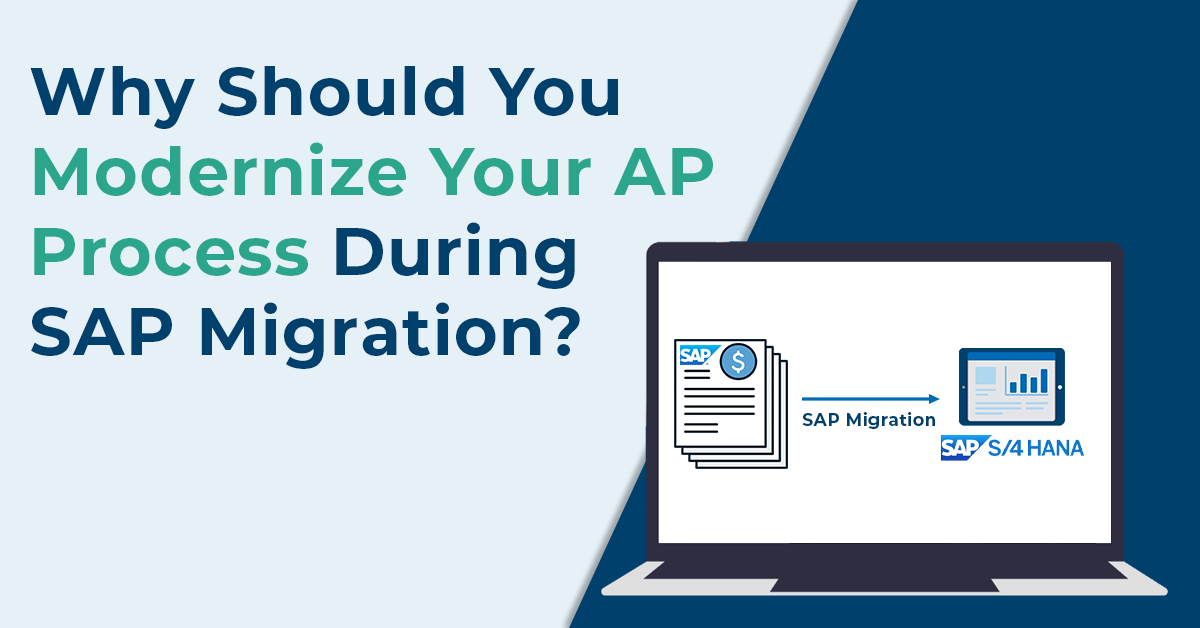
SAP migrations deliver a modern ERP but keep the outdated Accounts Payable (AP) challenges. As organizations transition from SAP ECC to SAP S/4HANA, many focus on technical readiness while overlooking process modernization.
However, automation is increasingly becoming a standard component of transformation programs. Many organizations are accelerating efforts to digitize AP to reduce manual processing and improve visibility.
According to Gartner, finance leaders are prioritizing automation to reduce manual processing and improve efficiency during ERP modernization.
With clean-core SAP S/4HANA projects accelerating in 2026, it’s smarter to include AP automation and invoice processing in the SAP migration plan rather than postponing it. Failing to modernize AP during migration means:
- Carrying inefficient workflows into a modern ERP
- Procrastinating migration timelines
- Missing an opportunity to simplify finance operations
In this blog, we’ll explore why modernizing AP during SAP migration is essential for long-term efficiency, cost control, and scalability
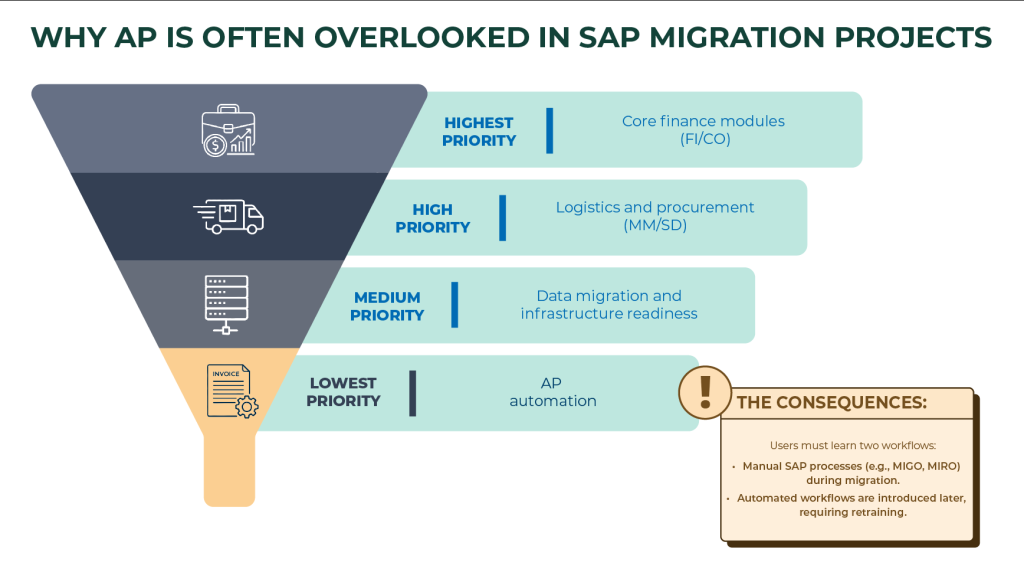
Why AP Is Often Overlooked in SAP Migration Projects?
During SAP transformation, organizations prioritize:
- Core finance modules (FI/CO)
- Logistics and procurement (MM/SD)
- Data migration and infrastructure readiness
As a result, AP is frequently pushed to “Phase 2.”
This is especially common in legacy SAP ECC environments where stabilization takes precedence over process optimization.
Many organizations assume SAP alone can handle AP transformation, but this belief often hides deeper SAP ERP limitations.
Delaying AP automation until after SAP migration forces teams to manage two separate processes. The consequence is users must learn two workflows:
- Manual SAP processes (e.g., MIGO, MIRO) during migration.
- Automated workflows are introduced later, requiring retraining.
This increases training effort, slows adoption, and creates unnecessary change fatigue.
Why AP Automation is Essential for Your SAP Migration?
Embedding AP automation into your migration roadmap ensures that invoice processing, workflows, and maintenance costs are optimized from day one.
1. Reduce IT Complexity and Redesign AP During SAP Configuration
- During SAP S/4HANA or SAP ECC migration, organizations already configure COA, tax codes, and vendor master data.
- Mapping these fields to AP automation at the same time integrates invoice processing in SAP and SAP invoice management from the start.
- This avoids later rework and reduces IT complexity
2. Reducing Total Cost of Ownership (TCO)
- Adding AP automation while consultants are working on SAP lowers implementation costs compared to a separate project.
- IT and finance teams are already in project mode, preventing additional rollout cycles.
- Fewer testing phases, shorter migration timelines, and lower maintenance reduce overall TCO.
3. Better Data Quality from Day One
- AI/ML-based invoice capture validates data before it enters SAP S/4HANA, supporting a clean core strategy.
- Improved invoice reconciliation reduces errors, exceptions, and manual corrections.
- Real-time visibility into liabilities means finance teams can instantly see pending and approved invoices during the move to the new SAP environment.
4. User Adoption and Change Management
- Launching SAP and AP automation together creates one learning curve instead of two.
- Users avoid switching from manual SAP workflows to automation later.
- This improves adoption, reduces change fatigue, and increases productivity for SAP AP teams.
Ensure a Smooth SAP Migration with AP Automation
Solutions such as Compleo Invoice Platform (CIP) integrate with SAP using certified BAPI connectors, enabling secure real-time data exchange without heavy customization or disruptive system modifications. This SAP integration supports seamless invoice posting, status updates, and validation directly within SAP S/4HANA.
By leveraging BAPI-based connectivity, organizations reduce technical risk, simplify SAP integration, and ensure their accounts payable automation strategy aligns fully with their SAP migration roadmap. The result is a smoother transition, stronger process governance, and a scalable finance foundation built to support long-term growth.