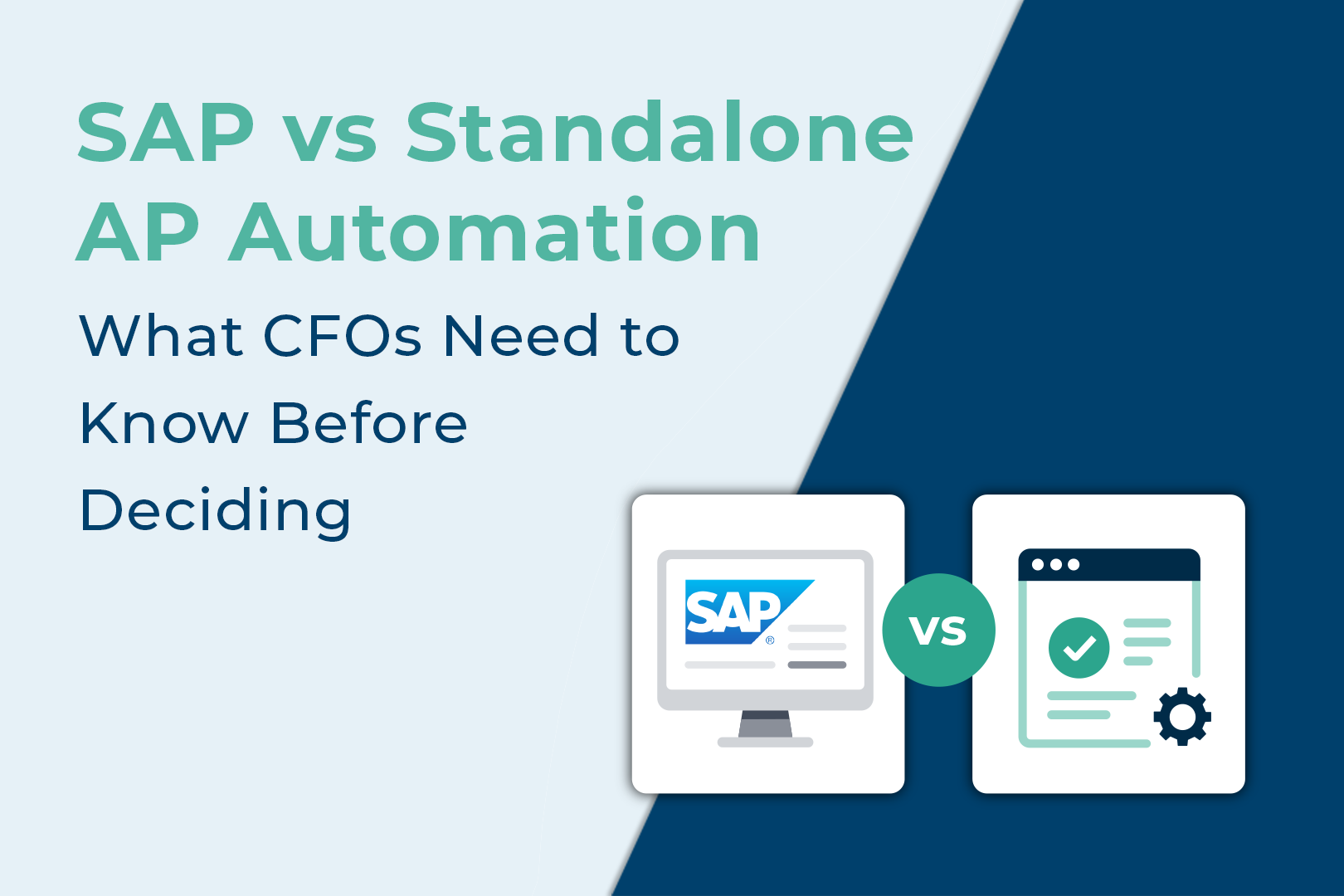
Most CFOs ask the same question: “We already have SAP; why would we need another tool?” After all, ERPs like SAP S/4HANA and SAP ECC already handle core finance operations, including accounts payable (AP).
As you allocate that budget, the debate between relying on native SAP AP automation and investing in specialized (AP) automation software heats up. According to Deloitte’s Q4 2025 CFO Signals Survey, 50% of North American CFOs say digital transformation of finance is their top priority for 2026.
The real question isn’t simply which system is “better.” It is “What does your specific AP operation need, and who owns the outcome when something breaks?”
With invoice volumes rising, the struggle to manage complex workflows using standard SAP AP makes the pressure to invest in a dedicated AP solution even sharper. The risk isn’t choosing wrong. It’s choosing fast, without a clear evaluation lens.
What “SAP-Native AP Automation” Actually Means in 2026
In 2026, SAP-native AP automation typically refers to the AP capabilities embedded within SAP S/4HANA, SAP ECC, or mid-market solutions such as SAP Business One. These platforms provide foundational support for managing payables, offering standard features like invoice uploads, vendor management, basic PO matching, and email-based approvals.
However, they are not purpose-built AP automation software. The primary role of SAP S/4HANA is still that of an ERP software, with a focus on managing core business operations across finance, procurement, supply chain, etc.
Even with various add-ons, finance teams relying solely on standard SAP AP modules quickly encounter costly operational bottlenecks:
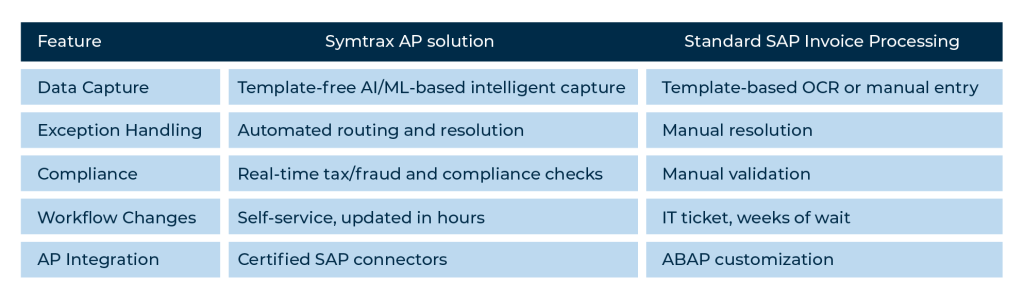
- High Cost of Customization: While basic 3-way matching exists in invoice processing SAP, any custom rules or exception logic requires ABAP development.
- Rigid Workflow Approvals: Standard SAP routing rules are highly rigid. Adapting your AP workflow automation to new business needs requires direct IT involvement.
- Lack of Intelligent Capture: Native SAP lacks built-in OCR or intelligent document capture. Invoice ingestion is manual and requires third-party bolt-ons or SAP’s own Intelligent Invoice Express (IIE) based on SAP Business Technology Platform (BTP) to digitize incoming data.
- Audit Trail Gaps: While activity logs exist within the SAP, they are not designed for auditor-ready reporting.
In practice, SAP-native tools often deliver surface-level automation but rarely eliminate the need for invoice automation and AP workflow automation. We cover these limitations in detail here.
For CFOs, this raises a critical operational question: “How often does your finance team depend on IT just to adapt AP workflows?”
What Standalone AP Automation Software Brings to the Table?
Unlike native SAP modules, a dedicated AP automation solution is engineered specifically to master the entire invoice lifecycle. Rather than just logging transactions, a specialized AP solution goes far beyond basic capture and 3–way matching to intelligently drive non-PO coding, automate complex exception handling, and enforce built-in compliance across every vendor invoice.
This purpose-built invoice processing solution has distinct advantages:
- Complete Lifecycle Management: End-to-end control over the entire invoice processing journey, minimizing manual touchpoints.
- Universal Format Support: Built-in capability to ingest and process invoices in diverse formats, including PDF, XML, JSON, etc., ensuring seamless invoice automation.
- Agility and Independence: Every workflow change in SAP, a new approver, or a revised routing rule goes through IT. With a dedicated AP automation solution, finance teams make those changes themselves, in hours.
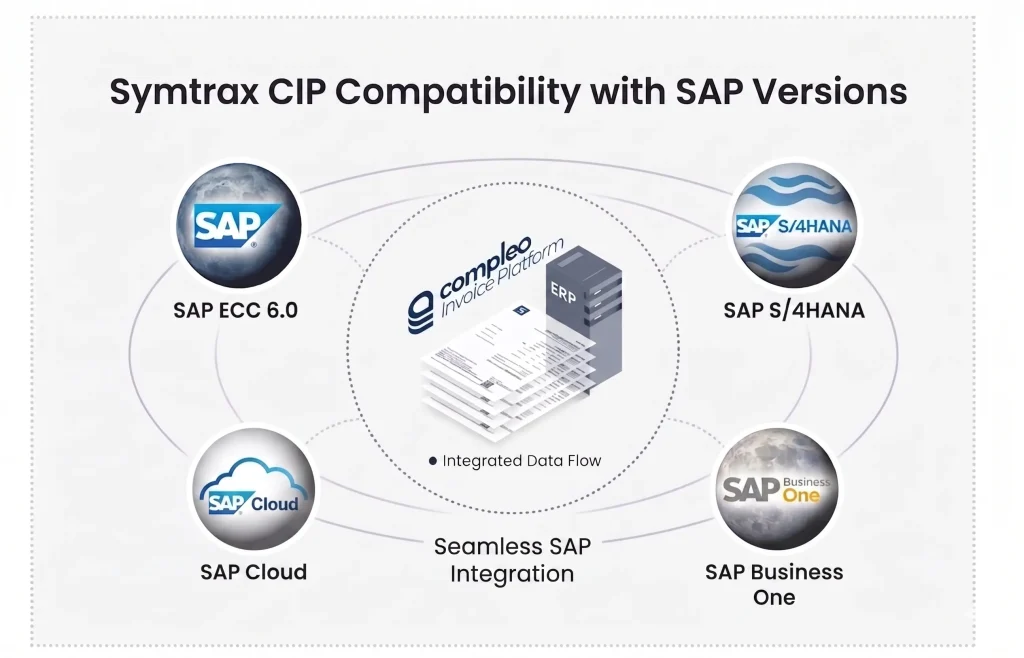
- SAP-native integration without SAP-native limitations: Automate invoice processing seamlessly with SAP while preserving a clean ERP core, reducing IT dependency, lowering maintenance costs, and simplifying future SAP upgrades.
If you are currently planning or midway through an SAP migration, this decision becomes even more critical. Here is why modernizing AP during SAP migration protects your investment from day one.
When SAP-Native Makes Sense vs. When It Doesn’t
Native SAP AP automation is viable only for highly standardized, low-complexity operations. If your finance team processes a predictable volume of uniform invoices, and your IT department has the bandwidth required to manually code and maintain basic workflows, native modules will suffice. This approach can work for organizations with simple AP requirements and strong IT support, regardless of company size.
Conversely, dedicated AP automation software becomes essential the moment invoice volume and format complexity scale. If your business receives diverse invoice formats across multiple regions and requires flexible approval workflows without IT intervention, a specialized AP solution is required.
The CFO Decision Criteria for AP Automation: 7 Questions to Ask
Look beyond just the sheer number of invoices. Consider your format diversity, AP team size, locations, and the complexity of your daily routing workflows.
If every adjustment to your AP workflow automation requires an IT support ticket, you lose agility. Your team needs a system that allows them to update routing rules instantly and independently.
Factor in implementation, ABAP customization, maintenance, and SAP upgrade risk.
Yes, the right solution connects seamlessly while strictly preserving your SAP clean core.
A high-performing AP solution should intelligently handle discrepancies, resulting in fewer invoices requiring human intervention.
Without dedicated AP automation, companies typically leave 1–2% of invoice value on the table. Your solution must stop this cash leakage and minimize statutory audit risks.
Conclusion
Deciding between native SAP modules and a dedicated AP solution isn’t replacing your core system; it’s maximizing its value. While SAP S/4HANA and SAP ECC provide a rock-solid financial foundation, they simply aren’t built to manage the complex, multi-format chaos of modern vendor billing.
True AP workflow automation reduces manual touchpoints, lowering your cost per invoice and protecting your SAP clean core.
The CFOs who get this right are not replacing SAP. They are extending it purposefully with the right invoice automation layer.
See how the Compleo Invoice Platform (CIP) delivers flexible supplier invoice workflow automation for SAP S/4HANA without touching your core system.