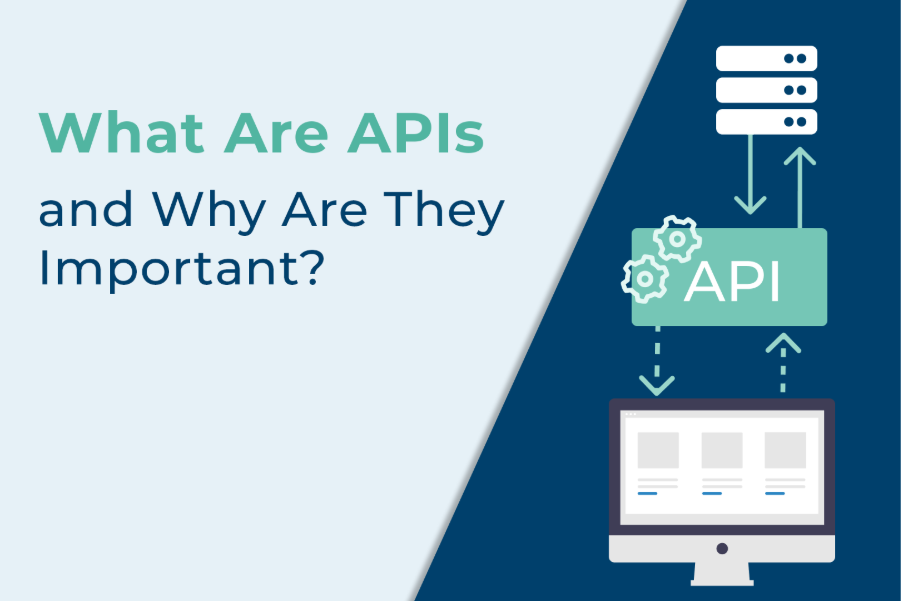
APIs, or Application Programming Interface, play a crucial role in software development. They are essential elements for many of the digital solutions we use daily.
What is an API?
Application Programming Interfaces, commonly known as APIs, act as intermediaries between various computing platforms. They allow distinct applications to communicate with one another by exchanging data or services.
APIs thus offer developers the ability to create efficient and flexible solutions by leveraging existing functionalities without having to rebuild everything from scratch.
How Does an API Work?
An API provides a set of commands and specifications used to request particular services from an application. The API acts as a gateway, receiving requests, processing them according to pre-established rules, and returning results in an orderly manner.
To illustrate, consider a social media application like X (formerly Twitter). When you view your feed on X, the application uses API calls to retrieve the most recent tweets (posts) from your network. These API calls allow the application to constantly stay updated with the latest information without having to manually reload the page. Furthermore, if you interact by posting a tweet or liking a message, the application makes API calls to update the data on the X server (formerly Twitter). This is made possible thanks to APIs that facilitate communication between your X application and the X servers. This type of API is called a web API.
Thus, in technical terms, APIs operate on a client-server architecture. In this context, the “client” wants to access data or use the functionalities of a remote application; it therefore sends a request to that application server via the appropriate API. The “server” is the application that receives this request, processes it, and then sends a response back to the client.
The Four Types of Web APIs
Today, the majority of application programming interfaces (APIs) are web APIs, thus exposing an application’s data and functionalities to the internet. There are four main types of APIs: public, partner, private, and composite.
- Public or open APIs
Public APIs are intended to be accessible to a wide audience. They are designed to allow developers or third-party companies to access specific applications, services, or data.
An example of a public API is the Google Maps API. This API allows developers to integrate mapping and geolocation features into their applications or websites. Imagine a ride-sharing company that wants to use the Google Maps API. With this API, it can incorporate interactive maps into its application, allowing users to view routes, locate passengers, estimate travel times, and more.
- Private or closed APIs
Private APIs, on the other hand, are used within an organization. They facilitate communication between different parts of the same departments or between internal systems
For example, a private API can be used to establish communication between a human resources management (HRM) system and an internal payroll system. The company can then access information such as work schedules and leave while simultaneously having a payroll system that calculates employees’ salaries.
- Partner APIs
A partner API is intended for restricted use and is not publicly accessible. It requires a strong authentication mechanism and specific authorization granted to trusted partners.
Imagine a bank that wants to allow external partners, such as online brokers or third-party financial applications, to access specific information about their clients’ accounts. The partner API would be designed to offer controlled and secure access to data (account balances, regular transactions, etc.) only to authorized partners with the clients’ prior consent.
- Composite APIs
Composite APIs combine multiple APIs into a single interface, facilitating their simultaneous interaction. It allows access to multiple services or data through a single request, thus simplifying the integration process within applications. This means only one call is made to the server, and only one response is sent back. Using composite APIs can help reduce latency in interactions between applications and servers because it minimizes the number of network calls required.
Example: Imagine an e-commerce application processing a customer’s checkout. Instead of making three separate API calls to (1) create the order, (2) process the payment, and (3) update the inventory, a composite API allows the application to send a single “Place Order” request. The server then handles all three tasks internally and returns one unified confirmation to the customer. This significantly reduces waiting time and mobile data usage.
Note: APIs are not designed to handle individual user authentication directly. Therefore, it is necessary to implement authentication protocols (to secure access to APIs) by authenticating client applications. Standard API authentication methods include API keys, OAuth, basic HTTP authentication, or JWT (JSON Web Token) authentication, which we offer at Symtrax.
Do you want to secure your data exchanges between partners using APIs?
What is a REST API?
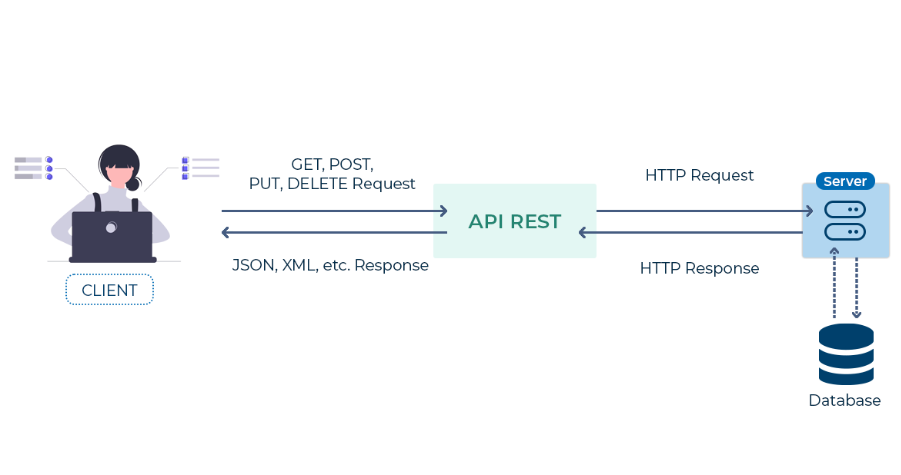
Among all API architectures, the REST (Representational State Transfer) API is the most widely used. – It has gained popularity due to its simplicity and flexibility. When a user makes a request to the server via a RESTful API, they are using the HTTP (Hypertext Transfer Protocol) to perform the action and return the appropriate data format (typically JSON or XML). The most used HTTP commands include:
GET – Display a resource
POST – Create a new resource
PUT – Update a resource
DELETE – Delete a resource
For example, when a customer requests a specific product from an e-commerce server and wants to receive the information in XML format, the request might look like this:

The response content is formed by the resource representation. The server’s response (XML representation) is therefore as follows:

A resource can have multiple representations in other formats (e.g., JSON format) depending on the client’s request.
What are the characteristics of a REST API?
The main characteristics of a REST API are as follows:
- Stateless: The API does not retain any state or data between requests. Each request from the client to the server contains all the information needed to process it.
- Client-Server Architecture: The clear separation between client and server components offers the possibility of modifying and updating each component independently, without affecting the other.
- Uniform Interface: This ensures a standardized and consistent way for developers to interact with the API. Resources use standardized URI (Uniform Resource Identifier) structures and HTTP methods, making communication between clients and servers predictable and easier to manage.
- Resource caching: REST architecture offers clients the ability to cache responses. Data can then be saved and reused for a defined period.
- Multi-layered system: An API can be structured into different layers to facilitate request management, data processing, and the delivery of results to clients. Each layer plays a specific role (caching, load balancing, etc.).
- Code on demand (optional): the server has the option to send a code snippet to the client for download and execution.
Resources: There are several essential tools related to API development and testing.
Swagger: This library is often integrated into web API development. It allows the automatic creation of a web interface that lists and allows testing of the different methods offered by the API.
Postman: This is an essential tool for testing and developing web APIs. Available online or as a local installer, it is highly recommended for discovering the world of APIs and acquiring all the necessary knowledge.

Thanks to their ability to facilitate the rapid exchange of information between different applications, APIs contribute to optimizing operational processes.
Symtrax offers its Compleo Hybrid solution, designed to accelerate the exchange of your business documents via APIs. Using a universal REST API driver, Compleo Hybrid simplifies communication by fostering fast and efficient interaction between business partners. Compleo Hybrid simplifies communication by fostering fast and efficient interaction between business partners.
Send invoices, purchase orders, or other documents and receive instant responses from multiple suppliers or customers via a single API.