- Introduction
- The Complexity of International Invoicing
- 3 Biggest Risks of Working Without E-Invoicing Software
- How to Choose Multi-Country E-Invoicing Software for Global Operations: 6 Features That Actually Matter
- 7 Crucial Questions to Ask Any Invoicing Software Vendor Before You Sign
- How Compleo Invoice Platform (CIP) Delivers This
- Conclusion
- Book A Demo
Introduction
E-invoicing is rapidly becoming the standard across global markets, and governments aren’t waiting. Because of this, choosing the right software for global operations is not just a procurement task; it is a necessary move to ensure your business stays fully compliant with evolving e-invoicing mandates.
Relying on fragmented, manual billing acts as a magnet for government tax audits. This outdated approach inflates operational costs precisely when governments worldwide are mandating Peppol adoption and ViDA is reshaping VAT reporting across Europe.
The Complexity of International Invoicing
International invoicing is the process of creating, sending, and tracking invoices across borders while meeting each country’s unique tax laws and e-invoicing mandates.
It looks simple, but the reality is far more complex. EN 16931 gives Europe a common framework, yet each country still applies its own:
- Custom Schemas: Every country has its own invoice formats and validation rules. What works in one will be rejected in another.
- Workflows: B2B and B2G transactions frequently require entirely different formats and workflows.
- Different Invoicing Models: In some invoicing models, your outbound workflows must route invoices through local tax authorities for real-time validation before they can be legally sent to the buyer.
That is why the right e-invoicing software matters. Without it, finance teams are left managing format changes, tax rules, currency handling, and compliance updates manually. The result is slower processing, more rejections, and higher audit risk.
3 Biggest Risks of Working Without E-Invoicing Software
To expand safely, global businesses need dedicated e-invoicing software. Managing international outbound invoicing manually, or using basic tools without automation, exposes your business to three major problems:
- Tax Laws and Invoice Format:
Every country mandates its own structured invoice format. In Continuous Transaction Controls (CTC) markets like India, Saudi Arabia, and Malaysia, invoices that fail XML or JSON schema validation are rejected at the government portal before reaching your buyer.
Italy, France, Poland, and Romania all operate or are rolling out centralized CTC mandates. See our full European e-invoicing deadlines guide for timelines.
- Currency complexity:
Fluctuating exchange rates turn multi-currency billing into a margin of risk.
In strict markets like Malaysia, foreign currency invoices must include the exact exchange rate. If your software misses this single field, the government instantly rejects the invoice.
- Language Barriers:
Invoicing across borders means dealing with buyers and tax authorities in different languages; for example, in Saudi Arabia, ZATCA mandates Arabic on all e-invoices; English alone does not comply. Without automated language support, every market with a local language requirement becomes a manual barrier.
How to Choose Multi-Country E-Invoicing Software for Global Operations: 6 Features That Actually Matter
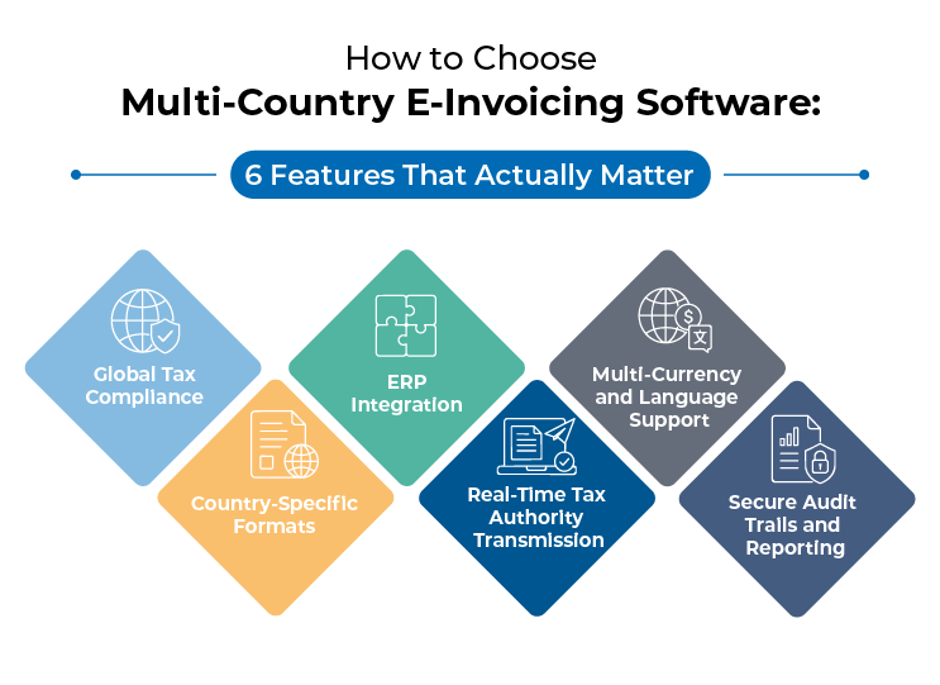
- Global Tax Compliance: The e-invoicing software must automatically handle outbound B2B and B2G mandates in every country you operate. It needs built-in pre-submission validation to ensure every invoice you issue follows local laws perfectly before it is sent.
- Country-Specific Formats: Your e-invoicing solution must automatically convert ERP data into each country’s mandated formats (like XRechnung, UBL 2.1, FatturaPA, UN/CEFACT CII, and Peppol BIS3.0) including hybrid formats like Factur-X (PDF/XML).
- ERP Integration: Your e-invoicing solution must connect directly to your existing ERP systems (like SAP S/4HANA, Oracle, Microsoft Dynamics 365, NetSuite, etc.).
- Real-Time Tax Authority Transmission: To meet strict new mandates, the system must instantly connect to government portals globally (such as India’s IRP, Malaysia’s MyInvois, Saudi Arabia’s ZATCA, Italy’s SDI, Mexico’s SAT, UAE and Oman tax platforms, etc.
- Multi-Currency and Language Support: To process cross-border transactions seamlessly, the platform must support multiple currencies and automatically generate invoices in the local language required by each foreign government.
- Secure Audit Trails and Reporting: The platform must capture and store highly detailed logs of every outbound invoice transaction. Generating global compliance reports is essential for surviving government tax audits and demonstrating international invoice compliance to regulators on demand.
7 Crucial Questions to Ask Any Invoicing Software Vendor Before You Sign
- How many countries should multi-country e-invoicing software actively support?
The broader the coverage, the better. It should cover all markets where you currently hold VAT registrations.
- How quickly should the software update for new tax mandates?
Your vendor should track regulatory changes across all markets and release compliance updates well ahead of mandate deadlines.
- Does the platform need to support legally compliant digital archiving?
Yes. Your platform must archive both inbound and outbound invoices in a country-specific format.
- Should the system automate outbound (AR) invoicing for global buyers?
Yes. The platform should extract data directly from your ERP, validate it against local tax rules, and deliver invoices in the exact format each government requires.
- Should the platform process inbound supplier invoices in any format?
Yes. A capable platform handles all of them, eliminating the need for separate inbound and outbound tools.
- Should it support hybrid invoices like Factur-X?
Yes. The platform should generate a single file containing both a human-readable PDF and machine-readable XML.
- Can it handle high transaction volumes?
Yes, the platform must process high volumes instantly without slowdowns or failures that disrupt your billing cycle.
How Compleo Invoice Platform (CIP) Delivers This
The Compleo Invoice Platform (CIP) by Symtrax is a centralized, multi-country e-invoicing solution built to handle the complexities of global operations. CIP seamlessly integrates with your existing ERP without requiring complex backend changes. It automatically converts invoices into structured data formats, instantly routing them to global government portals and the Peppol network. Whether you are automating outbound cross-border transactions or receiving inbound supplier invoices, CIP ensures your finance team stays 100% compliant and audit-ready.
Conclusion
As e-invoicing mandates expand across every major trade corridor, the question is no longer whether to automate; it is whether your platform can keep up. The right e-invoicing software connects your ERP directly to local tax authorities, handles every format, and updates automatically as regulations change. Stop letting compliance complexity slow your growth.
Ready to see how Symtrax handles outbound and inbound e-invoicing across the globe?