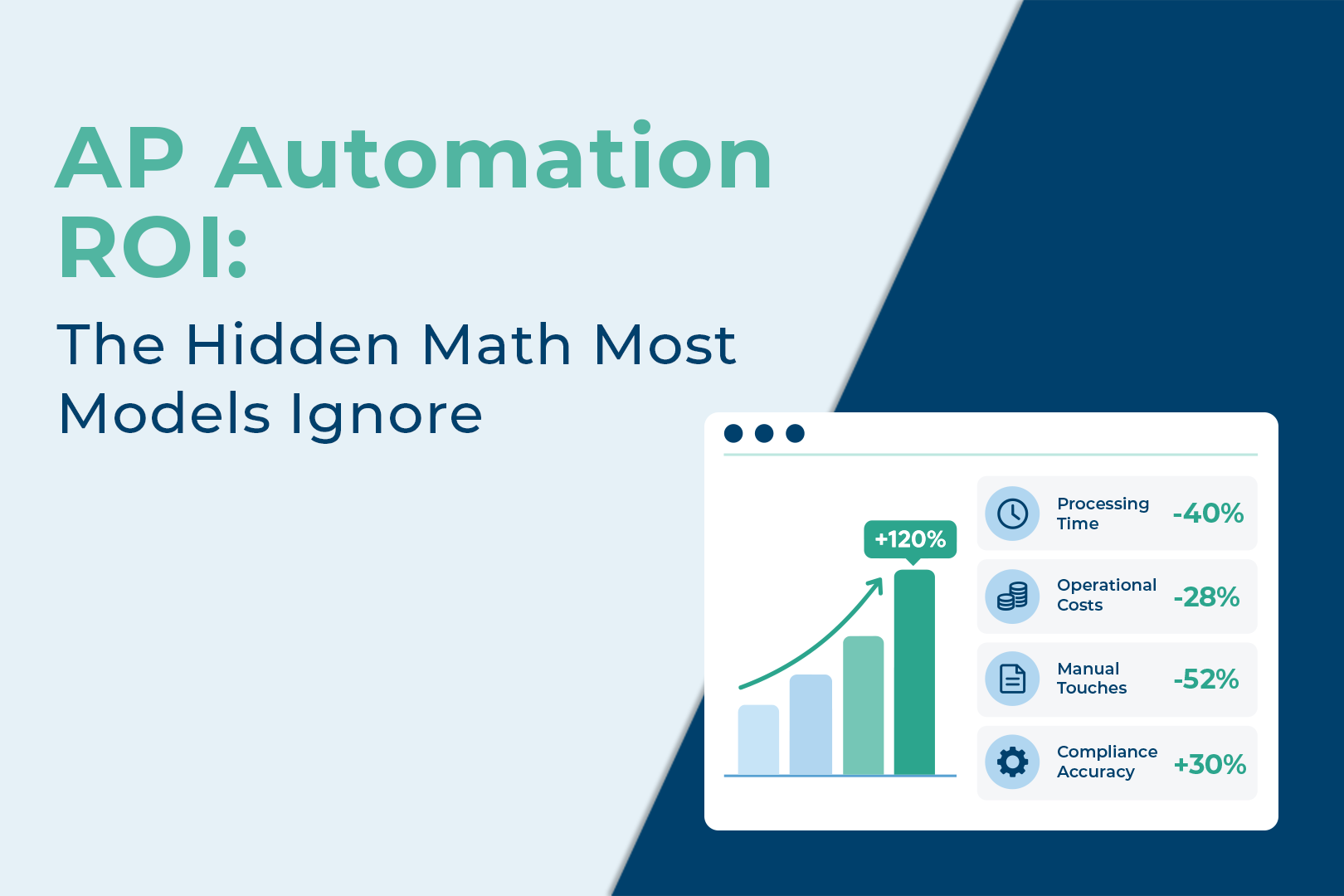
AP automation ROI is about more than software pricing versus staff salaries. A true return on investment (ROI) accounts for hidden operational drains: error correction, approval delays, duplicate payments, and manual invoice matching, which is exactly why most published ROI figures drastically underestimate real savings.
Manual processing carries direct costs too: missing early-payment discounts and severe late fees. Read our breakdown of the real cost of manual invoice processing. According to international business research on commercial payments, payment delays average 14 days, with 40% of businesses reporting that late payments actively suppress their growth and investment plans, and 31% stating delays threaten their survival. In major markets like the UK alone, chasing unpaid invoices drains 133 million working hours each year, creating an annual economic drag of £11 billion.
These recurring delays create friction, eroding vendor trust and straining critical B2B communication channels. As organizations demand complete end-to-end automation, the Accounts Payable Invoice Automation (APIA) market is scaling rapidly, projected to grow from approximately $925 million in 2021 to nearly $1.75 billion by 2026 at a 14% CAGR.
What Is the ROI of AP Automation?
The ROI of AP automation, also called Accounts Payable Automation ROI, is the value you get from automating invoice workflows, measured against what it costs to implement and maintain its total cost of ownership (TCO). That return spans two dimensions: direct, immediate savings, and indirect, longer-term value.
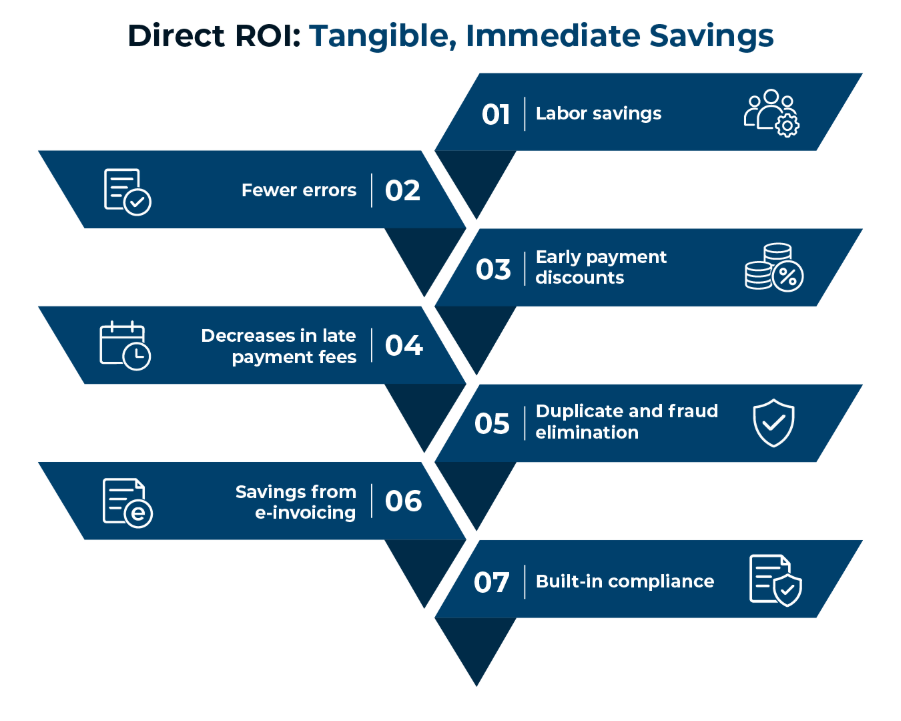
Direct ROI: Tangible, Immediate Savings
Direct ROI refers to the quantifiable cost savings realized by replacing manual tasks with automated workflows. Gartner highlights that typical benchmark targets for a successful deployment include achieving a touchless processing rate above 50% and cutting the end-to-end capture-to-pay cycle time to under 7 days.
The primary drivers of this direct financial return include:
- Labor savings: less time spent on manual data entry, routing, and matching documents.
- Fewer errors: less rework required to fix coding mistakes and data typos.
- Early payment discounts: faster approvals catch more vendor discounts.
- Decreases in late payment fees: fewer penalties from slow approvals.
- Duplicate and fraud elimination: automated checks flag anomalies instantly.
- Savings from e-invoicing: less spent on paper, postage, and filing.
- Built-in compliance: checks enforce the right format and rules automatically.
This value is not theoretical. Symtrax’s guide on why growing businesses must digitize accounts payable explains that transitioning from manual workflows to automated capture eliminates data-entry mistakes, accelerates invoice approvals, streamlines 3-way matching, and prevents late fees and duplicate payments.
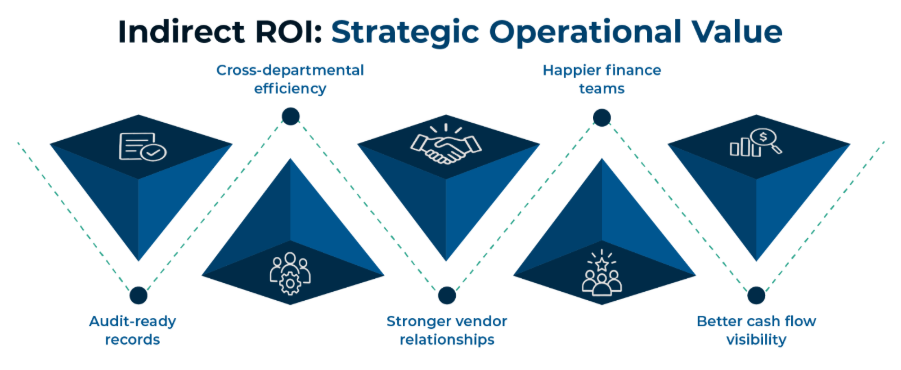
Indirect ROI: Strategic Operational Value
While secondary benefits are harder to measure in exact financial gain terms, they improve operational agility and protect the organization’s overall financial performance. This indirect ROI stimulates massive long-term business value.
It shows up as:
- Audit-ready records: a full digital history and timestamp for every transaction.
- Cross-departmental efficiency: procurement, AP, and approvers share the same information across the procure-to-pay (P2P) workflows.
- Stronger vendor relationships: on-time payments build trust and reliable supply chains.
- Happier finance teams: less busy work means more time for the analysis.
- Better cash flow visibility: real-time insight into what you owe and when.
Why Most Published ROI Numbers Are Incomplete
Most published ROI numbers for AP automation measure the wrong thing: labor hours, not cost recovery. The hours a team stops spending on matching invoices or chasing approvals are real, but they’re not money recovered, and finance panels know the difference. Hidden integration work and fragmented processes can also weaken projected savings when they are left out of the business case. That’s a common AP automation ROI mistake: most quoted figures online only count what’s visible (software plus labor) and skip what’s hidden.
With over 150 AP automation vendors in the market, most rely on the same process automation shortcut: counting hours saved instead of actual money recovered. Gartner’s IT Score data highlights a better approach: mature organizations are 2.5 times more likely (72% versus 28%) to build a business case around real outcomes, not estimates.
The Importance of Measuring AP Automation ROI
Calculating ROI does more than justify an initial purchase; it shows where manual effort, invoice exceptions, approval bottlenecks, and cost per transaction are still eroding AP performance. To track these AP KPI indicators consistently, use the AP KPI Guide 2026. Ongoing measurement gives leadership verifiable proof that your AP automation platform is actively eliminating these bottlenecks over time.
Measuring ROI isn’t a one-and-done exercise at contract signing. In 2025, over 80% of CIOs changed their strategic plans and budgets at least 3 times as priorities shifted (Gartner). If you only check ROI once, at launch, you’ll have nothing to show the next time budgets get reviewed, whether the project is working or not.
A Simple Framework for Measuring AP Automation ROI
To move beyond generic projections, think of this as your own AP automation cost analysis or an accounts payable automation ROI calculator, in 3 categories:
1. Direct Staff & Processing Costs
- Full-time AP headcount & annual salary: your direct labor cost.
- Annual invoice volume: your transaction scale.
- Invoice error rate: your hidden rework cost.
2. Visible Automation Costs
- Annual software licensing and subscription fees: your total initial investment.
3. The Hidden Time Drains
Measure the percentage of working hours your team spends on:
- Searching for misplaced invoices
- Reading invoices
- Manual data entry
- Goods Received Note (GRN) creation
- Three-way matching (PO vs. GRN vs. Invoice)
- Chasing manual approval sign-offs
- Entering approved transaction into the ERP
- Handling of exceptions like mismatches and errors in vendor invoices
- Unclear communication with vendors about invoice status
How to Calculate the ROI of AP Automation
The AP Automation ROI Formula
ROI = (Total Benefits – Total Costs) / Total Costs × 100%
Total Annual Benefits = Direct labor reallocation savings + captured early-payment discounts + avoided late payment fees + error rework reduction + physical archival savings.
Total Annual Costs = Software licensing fees + implementation expenses + ERP integration overhead + continuous administrative support
Want the math done for you? Plug your own numbers into our free AP Automation ROI Calculator to see your projected 1-year return instantly.
Solving the AP Equation: Where Real ROI Begins
A credible AP automation business case cannot rely on unreliable “hours saved” or generic vendor benchmarks. Achieving true financial ROI requires measuring the complete TCO against the hidden operational drains of manual processing, including multi-step error correction, manual matching friction, and the cash flow impact of delayed approvals. By shifting focus to verified business outcomes, finance leaders replace speculative projections with a clear, defensible foundation for long-term operational efficiency.
Ready to identify where manual friction is draining your department’s budget? Schedule an AP workflow consultation with our solution specialists to evaluate your existing cycle times, pinpoint operational bottlenecks, and map out a structured automation strategy tailored to your ERP environment.
FAQ About AP Automation ROI
Most calculations usually track only software fees and basic data entry, overlooking the labor spent handling exceptions, creating GRNs, chasing department approvals, and fielding vendor inquiries. They also miss the hard financial drains left off most spreadsheets: lost early-payment discounts, late payment fees, duplicate payments, and the ongoing effort required for audit retrieval and reentering data in ERP.
Depending on invoice volume and complexity, most organizations achieve a positive payback period within 6 to 18 months, driven by faster processing cycles and reduced administrative overhead.
Yes. For smaller teams, targeted automation eliminates tedious data entry, automates matching, and prevents costly late payment penalties without requiring enterprise-grade custom engineering.
A healthy implementation targets cutting capture-to-pay cycle times down to under 7 days, reducing manual touchpoints by more than 50%, and capturing 100% of available early-payment discounts.
Manual processing cost equals total AP staff payroll, office supplies, storage, and error remediation divided by total invoice volume. Automated cost combines annual platform fees, maintenance, and the residual labor spent handling exceptions or approvals, divided by the total volume.
Most vendor models assume 100% of saved employee time immediately converts into recovered cash. Realistic models only count savings that directly offset overhead, prevent hiring, or capture discounts.