Europe’s VAT framework is undergoing its most significant digital transformation since the single market was established. In March 2025, the Council of the European Union formally adopted the VAT in the Digital Age (ViDA) package, a regulatory reform that came into effect on April 14, 2025, with phased implementation continuing through January 2035.
This blog sets out what the ViDA regulation covers, which organizations it affects, and why UK businesses with EU trading relationships need to understand how it may affect them.
What is ViDA?
ViDA (VAT in the Digital Age) is the EU’s legislative package to modernize VAT and reduce fraud by introducing digital reporting requirements for cross-border B2B transactions within the EU, giving tax authorities real-time visibility while easing compliance burdens for businesses trading across EU borders. As the most significant EU VAT reform since the single market was established, ViDA directly addresses the EU VAT compliance gap, which was estimated to be €128 billion in lost revenues in 2023 alone. For businesses evaluating how to meet these requirements, choosing the right e-invoicing solution is a critical first step.
The reform is structured around three core pillars: Digital Reporting Requirements (DRR), the Platform Economy, and Single VAT Registration (SVR).
The Three Pillars of ViDA
1. Digital Reporting Requirements (DRR) and E-Invoicing
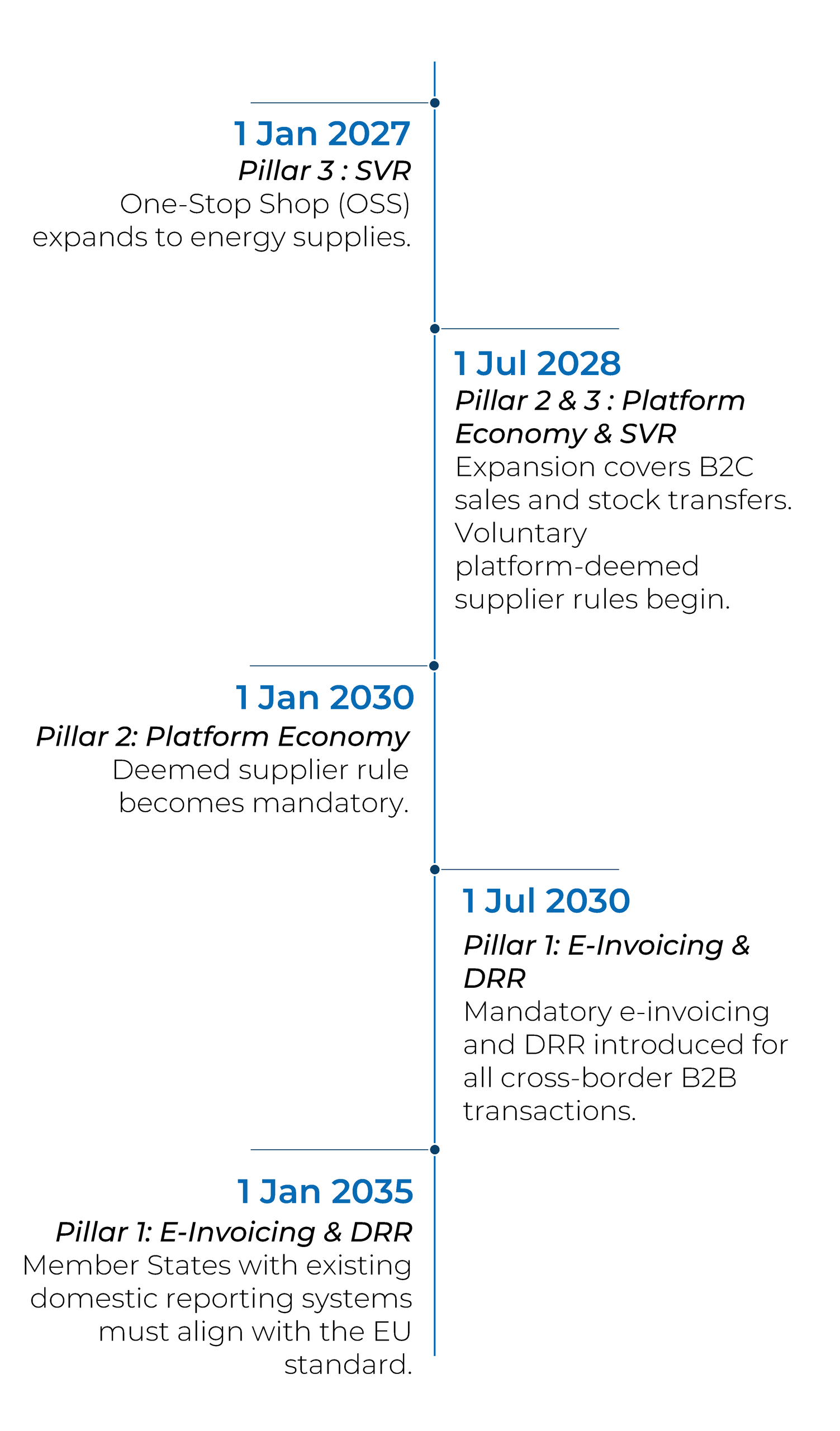
Effective July 1, 2030, this pillar mandates structured e-invoicing for cross-border B2B trade within the EU. All affected businesses will be required to issue structured e-invoices compliant with the EN 16931 standard. Under the amended Articles 222 and 263, invoices must be issued within 10 days of the chargeable event, which generally occurs when the goods or services are supplied. Suppliers must report the invoice data within 10 days of invoice issuance, while buyers, where required, must report within 5 days of receiving it.
2. The Platform Economy
Deemed supplier rules may be introduced from July 1, 2028, with member states able to delay mandatory enforcement until January 1, 2030. This pillar targets digital marketplace platforms, specifically those facilitating short-term accommodation and passenger transport by road. This regulation makes the platform responsible for collecting and remitting VAT to national authorities when the underlying service provider does not charge VAT.
3. Single VAT Registration (SVR) via OSS
Currently, businesses trading across multiple EU Member States may face the administrative burden of registering for VAT in each country separately. From January 1, 2027, the One Stop Shop (OSS) scheme expands to cover gas, electricity, heating, and cooling supplies, followed by a broader expansion on July 1, 2028.
This lets eligible businesses fulfill VAT obligations through a single registration, significantly reducing cross-border VAT compliance costs.
What Problem is ViDA Trying to Solve?
Europe’s VAT system was built for a paper-based economy. Decades on, it was struggling to keep pace with the scale and speed of digital commerce and VAT digitization across the single market. The European Commission designed ViDA to solve two deep-rooted, systemic problems threatening the European economy:
- The VAT Gap Problem: The EU has been losing tens of billions of euros annually due to tax fraud, insolvency, and administrative errors. ViDA’s real-time visibility is designed to combat VAT fraud directly.
- The Fragmentation Problem: Over the last decade, member states like Italy, France, and Poland have developed independent, localized digital reporting systems. This approach created severe compliance friction, complex technical hurdles, and immense administrative burdens for businesses operating across European supply chains. Read our guide to European e-invoicing deadlines to see how these differ.
The ViDA Implementation Timeline
How Does ViDA Change E-Invoicing Across Europe?
ViDA goes beyond fixing what was broken. It sets out three clear objectives to reshape European e-invoicing and VAT compliance for what comes next.
- Delivering an efficient and fair VAT system: Modernizing tax compliance to keep pace with the speed and scale of the digital economy.
- Simplifying cross-border trade: Standardizing digital reporting, giving businesses greater legal certainty when trading across EU borders.
- Reducing intra-community fraud: Equipping tax authorities with near real-time transaction data, making it significantly harder for VAT fraud to go undetected across borders.
What Does ViDA Compliance Mean for Your Business?
According to Council Directive (EU) 2025/516, unstructured invoices (like PDFs) will no longer count as valid e-invoices for VAT purposes in cross-border trade starting July 1, 2030. If an invoice is non-compliant, the recipient cannot legally recover the input VAT, and the issuing business may face financial penalties for failed reporting, depending on the applicable national law.
AR teams must issue invoices in structured formats such as UBL 2.1 or UN/CEFACT CII that are fully compliant with EN 16931, with the correct VAT treatment accurately reflected before the invoice reaches the customer. AP teams must be equipped to receive, validate, and process incoming structured e-invoices and, where required, report inbound transactions to national tax authorities.
For most businesses, deploying an e-invoicing solution integrated with the ERP is a practical necessity. Automation ensures that once an invoice is created, it is converted into the required structured format, sent to the customer through a network such as Peppol, and reported to the relevant tax authority at the same time.
How can Symtrax help you with ViDA?
ViDA is accelerating the shift to structured, real-time VAT reporting across the EU and creates immediate and future cross-border compliance needs for businesses trading within the EU. As a certified Peppol Access Point provider, Symtrax helps you establish the technical foundation for this transition today. Using our Compleo Invoice Platform (CIP), you can automatically convert and exchange EN 16931-compliant e-invoices while seamlessly integrating digital reporting directly into your existing ERP and AP/AR workflows. Contact us to find out how CIP can support your e-invoicing compliance journey.
FAQ
ViDA replaces EC Sales Lists (which are periodic reports summarizing certain cross-border B2B supplies within the EU) with near-real-time, transaction-level digital reporting. Suppliers and, where required, buyers report invoice data to their national tax authorities, which transmit it to a centralized EU database.
No. ViDA is an EU VAT reform, so it does not generally apply to UK businesses that operate only in Great Britain. It may affect UK businesses that carry out transactions subject to EU VAT rules, have EU establishments or EU VAT registrations, or participate in Northern Ireland goods trade.
ViDA is the legislative reform. EN 16931 is the technical standard defining what data a structured e-invoice must contain. ViDA requires businesses to issue invoices compliant with EN 16931.
ViDA rolls out in phases from 2025 to 2035. The most significant deadline for businesses is July 1, 2030, when structured e-invoicing and digital reporting become mandatory for cross-border B2B transactions within the EU.
Yes. An e-invoicing solution integrated with your ERP can convert invoices into the required structured format, transmit them to trading partners, and report transaction data to tax authorities automatically.