- Touchless Invoice Processing Explained in 30 Seconds
- What is Touchless Invoice Processing in Accounts Payable?
- The 5 Levels of AP Automation: From Basic to Touchless
- How Does Touchless Invoice Processing Work?
- Business Benefits of Touchless Invoice Processing
- Measuring AP Success: Key Metrics and a Hypothetical ROI Calculation
- Scaling Your AP Operations
- FAQ
Accounts Payable (AP) teams are drowning in invoices without matching increases in headcount. Ardent Partners reported 32.6% of invoices reach true touchless processing. The remaining volume relies on slow manual processing, stalling in email inboxes, and manual approval queues. This reliance on manual work inflates departmental costs, drags out month-end close, and heightens compliance risk.
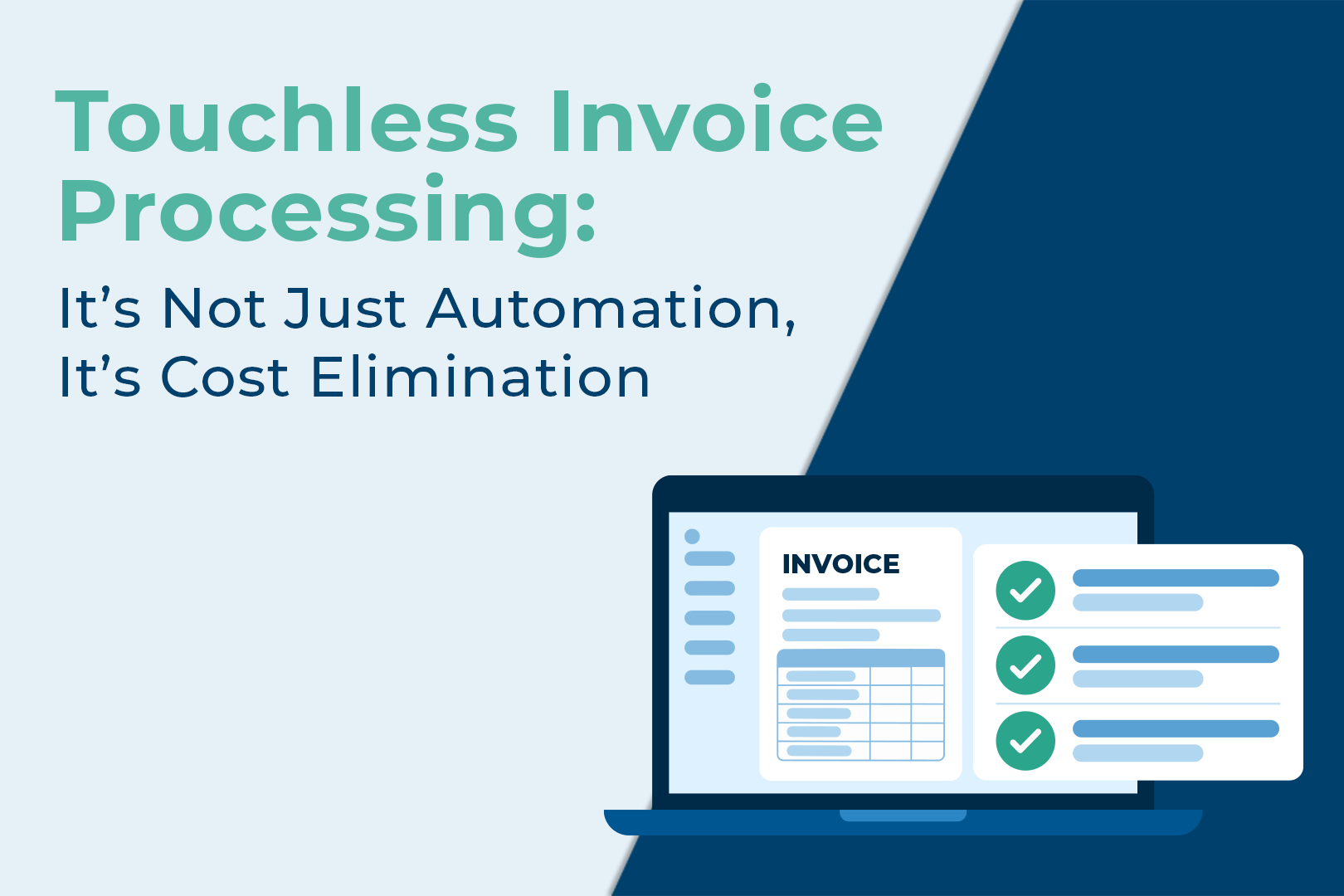
Touchless invoice processing eliminates this friction. By establishing an automated accounts payable process, compliant bills move from arrival straight to your ledger with zero touch.
Touchless Invoice Processing Explained in 30 Seconds
What is Touchless Invoice Processing in Accounts Payable?
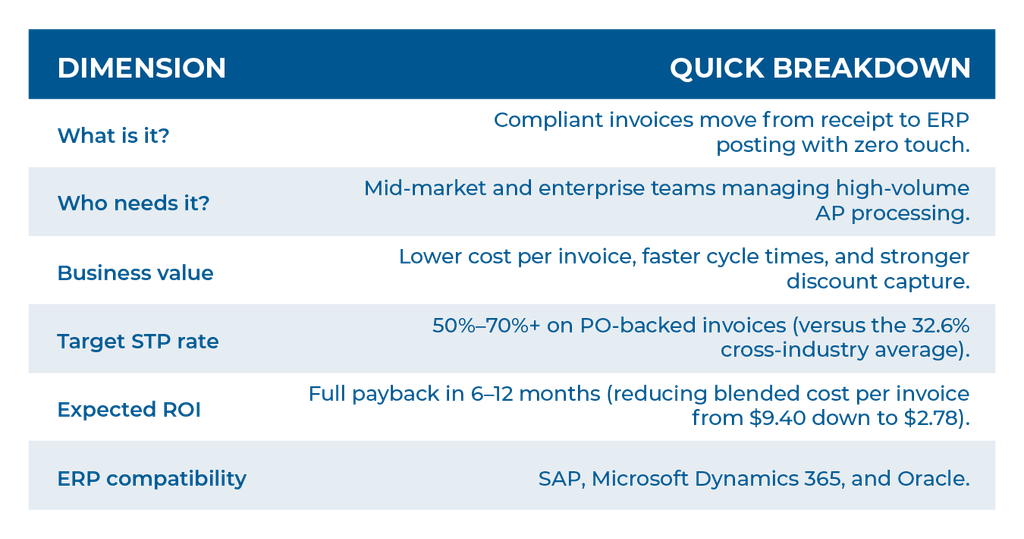
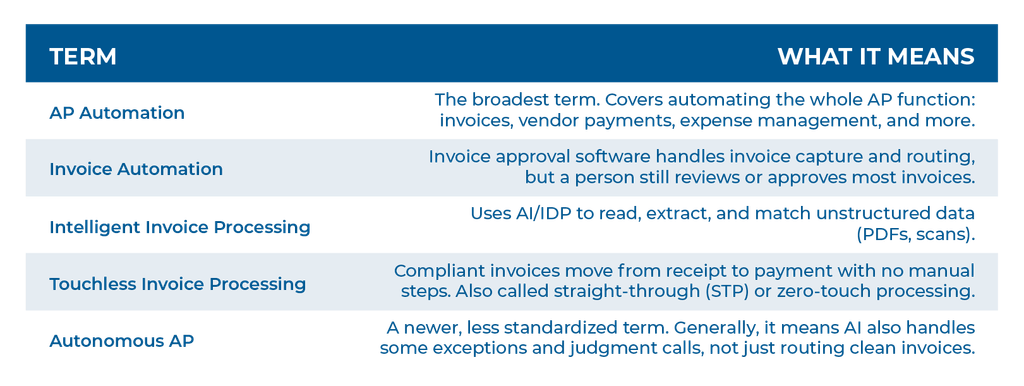
Touchless invoice processing, also known as straight-through processing (STP) or zero-touch AP, means an invoice moves from receipt to payment schedule without manual intervention. The goal is to drive routine invoices into direct approval and restrict manual effort strictly to exception handling.
Ardent Partners defines it as an end-to-end workflow where an invoice is received, validated, matched, and posted directly into the general ledger without a single manual click.
“A Note on Exceptions: True touchless processing does not mean 100% of invoices bypass human review. Knowing how to manage non-PO invoices in SAP and handle commercial pricing disputes will always require targeted human business judgment.”
The 5 Levels of AP Automation: From Basic to Touchless
How Does Touchless Invoice Processing Work?
Touchless invoice processing automation turns AP into a straight line from receipt to payment, step by step:
- Multi-Channel Ingestion (Touchless Invoice Capture): Invoices are ingested automatically from email, vendor portals, EDI, or e-invoicing networks in PDF, XML, or structured formats.
- AI Document Processing (IDP): Machine learning models extract vendor details, line items, taxes, and totals without manual typing or rigid templates.
- Automated 3-Way Matching & GRN Validation: Built-in validation rules cross-check billed invoices against purchase orders (PO) and Goods Receipt Notes (GRN) to verify pricing and fulfillment prior to approval. Understanding how to integrate GRN and invoice workflows is essential to ensure invoices are only paid when delivery is verified.
- Targeted Exception Routing: Clean matches move forward instantly, while discrepancies (e.g., price variances or missing GRNs) route directly to the designated dispute owner.
- Automated Direct Approval: Compliant PO invoices are approved instantly with zero human touch, clearing the transaction directly for payment scheduling without manual intervention.
- ERP Invoice Integration: Verified invoice data posts directly into your ERP (e.g., SAP, Microsoft Dynamics, Oracle). The platform leverages automated GL coding and account determination to update the general ledger in real time without manual data entry.
- Payment Scheduling: The system schedules disbursements based on agreed vendor terms to eliminate late fees and systematically capture early payment discounts.
- Audit Logging & Archiving: The platform maintains an unalterable activity log capturing every field extraction, matching result, and financial system sync to streamline audit reviews and meet retention mandates.
Business Benefits of Touchless Invoice Processing
Transitioning to straight-through processing (STP) converts AP from a transactional cost center into a strategic operational asset. Policy-based controls determine whether an invoice qualifies for straight-through posting.
- Zero-Touch Cycle Times (Instant ERP Posting): For compliant PO-backed invoices, touchless processing eliminates invoice cycle time entirely. The invoice is posted directly into the ERP the moment 3-way matching rules succeed.
- Near-Zero Processing Cost: Removing manual data entry lowers the marginal cost per invoice, driving the combined cost per invoice down toward best-in-class benchmarks.
- Early Payment Discount Capture: Fast, touchless posting clears invoices in minutes, allowing accounts payable to pay on time and secure cash discounts from suppliers.
- Fraud & Error Prevention: Built-in invoice matching automation cross-checks vendor master data, flags mismatched banking details, and blocks duplicate invoices before payment is released.
- More Capacity for Exceptions: Only exceptions requiring business judgment leave the autonomous workflow. AP teams stop reviewing routine invoices and focus strictly on price variances, missing receipts, and disputed invoices.
Measuring AP Success: Key Metrics and a Hypothetical ROI Calculation
To evaluate the operational impact of STP and benchmark your department against the core metrics detailed in our Accounts Payable KPI Guide, consider an enterprise processing 50,000 invoices annually.
By deploying an AP automation and workflow layer with native ERP invoice integration, the organization targets the single most impactful lever: the percentage of touchless invoices (the share of compliant invoices clearing automated 3-way matching for direct approval).
Pushing 70% of routine invoices into direct approval eliminates 35,000 manual interventions each year. This immediately impacts performance and operational cost.
Scaling Your AP Operations
While 100% touchless processing is an unrealistic target due to non-PO spend and commercial disputes, reaching 50% to 70% straight-through processing (STP) fundamentally accelerates your finance department’s business transformation. Removing routine manual processing protects data integrity, secures early payment margins, and gives finance leaders total control over cash flow.
To make touchless processing work at scale, enterprise AP requires an intelligent integration layer capable of connecting document workflows directly with existing enterprise systems. The Compleo Invoice Platform by Symtrax connects seamlessly with core ERPs, including SAP, Microsoft Dynamics, and Oracle, automating document flows, accelerating 3-way matching, and routing exceptions without disrupting existing financial architectures.
Contact Symtrax today to see how the Compleo Invoice Platform integrates directly with your ERP to achieve true touchless invoice processing.
FAQ
Solutions like the Compleo Invoice Platform use secure API connectors to connect directly with major ERPs.
Yes. The system automates 3-way matching by cross-referencing invoice line items, prices, and quantities against the Purchase Order (PO) and the ERP-stored Goods Receipt Note (GRN) before posting.
It creates an immutable, timestamped digital audit log for every transaction. This tracks user approvals, data extraction, and ERP postings to satisfy tax rules and prevent duplicate or unauthorized payments.
Mature teams with strong PO discipline can reach a touchless rate of around 50% to 70%. The remainder consists of non-PO spend and line-item discrepancies that require human exception handling.
Track cost per invoice, invoice cycle time, touchless/STP percentage, exception rate, early payment discount capture, duplicate payment rate, supplier payment inquiries, and Days Payable Outstanding (DPO).
Common obstacles include poor vendor data quality, unstandardized invoice layouts, delayed warehouse GRN entries, non-PO spend, and complex ERP integration requirements.
Yes. Solutions with certified SAP integration leverage standard BAPIs and APIs to post verified invoices directly into SAP ECC or S/4HANA without disrupting existing accounting rules or custom workflows.