- What is E-Invoicing in Ireland?
- What are the current E-Invoicing Regulations in Ireland?
- The 2028 E-Invoicing Mandate: What Is Changing?
- What is VAT in the Digital Age (ViDA)?
- What is the Ireland VAT Modernization Plan?
- How can I prepare Businesses for the B2B E-Invoicing mandate 2028?
- Secure Your Future with Symtrax
- FAQs
The Irish Revenue Commissioners, commonly known as Irish Revenue, areleading Ireland’s VAT modernization program. While the Business-to-Government (B2G) rules have been in place since 2019, the big shift is now coming to the private sector (B2B). Between 2028 and 2029, B2B e-invoicing will become legally mandatory. With the e-invoicing Ireland 2028 deadline approaching, every business needs a plan.
This guide covers what Ireland’s e-invoicing mandate means for your business, which businesses fall in scope, what compliance requires, and the practical steps to prepare before the deadline.
New to e-invoicing? Start with our full explainer.
What is E-Invoicing in Ireland?
E-invoicing in Ireland is the structured, electronic exchange of invoices in a machine-readable format. Unlike PDF or Word invoices, e-invoices contain structured data that can be processed electronically by accounting and ERP systems.
Here is what e-invoicing means under the current rules and what will change when the Irish e-invoicing mandate takes effect.
What are the current E-Invoicing Regulations in Ireland?
- PDF and paper invoices: Freely issued in B2B.
- Structured B2G e-invoices: Public entities must receive them via Peppol. The supplier may issue it voluntarily but requires the EN 16931 standard.
- Structured B2B e-invoices: Require mutual agreement between both parties before sending.
- Peppol BIS 3.0: Highly encouraged for Peppol e-invoicing in B2G structured invoices; not mandatory.
- B2C transactions: Not currently in scope under Ireland’s VAT regime.
- E-Signature: Not Mandatory.
The 2028 E-Invoicing Mandate: What Is Changing?
- Structured e-invoicing: Mandatory for large VAT-registered corporates to issue domestic B2B e-invoices, but all businesses must be equipped to receive them.
- Supported formats: EN 16931-compliant invoices (no PDFs or paper), with exact formats and transmission requirements to be confirmed by Irish Revenue.
- Real-time reporting: Subset of invoice data reported directly to Irish Revenue.
- Peppol network: expected to expand to B2B.
- EU ViDA directive: Ireland’s mandate aligns and prepares businesses for full ViDA compliance.
What is VAT in the Digital Age (ViDA)?
The VAT in the Digital Age (ViDA) initiative is designed to modernize the European Union’s tax system. Officially approved on March 11, 2025, the package completely streamlines how businesses handle VAT across Europe. The initiative is built around three main areas of modernization, namely mandatory cross-border e-invoicing, new tax rules for the platform economy, and a single VAT registration system.
Ireland’s mandate directly implements the Digital Reporting Requirements (DRR) set out by the EU’s ViDA framework.
What is the Ireland VAT Modernization Plan?
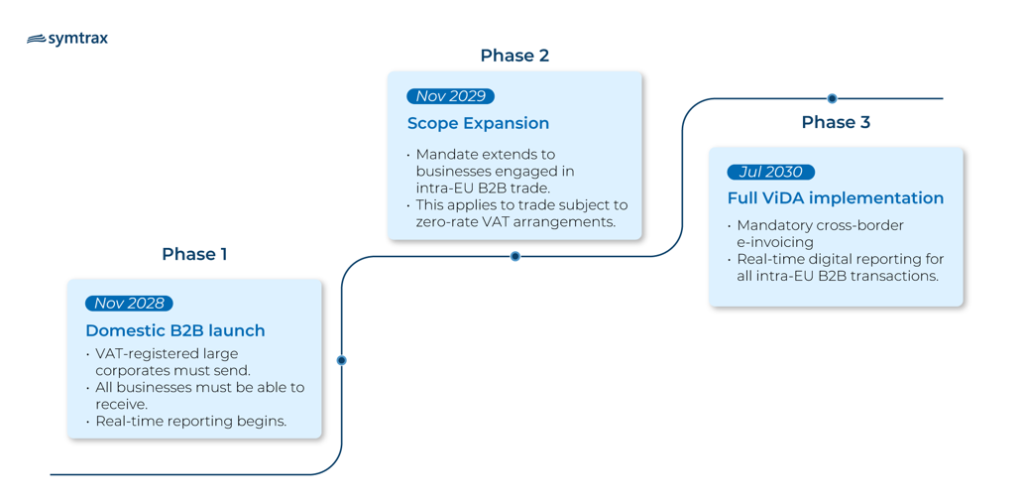
Ireland’s VAT Modernization Plan is the roadmap set out by Revenue, Ireland’s tax authority, to transform VAT reporting and invoice exchange across all business sectors. Real-time digital reporting is expected to help the Revenue close the VAT gap and reduce tax fraud. The plan aligns directly with the EU’s ViDA directive and rolls out in phases between 2028 and 2030. Ireland is not alone; see all B2B e-invoicing deadlines across Europe.
How can I prepare Businesses for the B2B E-Invoicing mandate 2028?
The e-invoicing Ireland 2028 deadline is fixe. How prepared your business is now will determine how smoothly you adapt when the mandate takes effect. SMEs with limited IT resources face the biggest challenge and need to start preparing immediately. Begin by assessing your current invoicing against EN 16931 requirements. Check if your ERP can handle e-invoicing and identify any data quality gaps in your systems.
Verify that your VAT identification numbers, tax classification codes, and business legal names are consistent and accurate wherever they appear in your systems. Train your finance and IT teams on the new processes. Run a test with a few B2B customers to see how the system works. Finally, ask your e-invoicing software provider what their ViDA roadmap looks like so you know your business will be ready for B2B e-invoicing in Ireland by November 2028.
Businesses operating across both Ireland and the UK face two separate compliance timelines. Learn how the UK e-invoicing mandate differs.
Secure Your Future with Symtrax
Ireland’s 2028 e-invoicing mandate will require businesses to move from manual invoice handling to structured, compliant digital exchange. Symtrax, as a certified Peppol Access Point Provider, helps you make that transition without disrupting your ERP or finance operations. With Compleo Invoice Platform (CIP), you can connect securely to the e-invoicing network, exchange structured invoices in the required format, and stay ready for Ireland’s upcoming invoicing mandate 2028.
FAQs
Starting in November 2028, large Irish corporates must issue EN 16931-compliant structured e-invoices for domestic B2B sales and report the data to Revenue in real-time. Simultaneously, all VAT-registered businesses must implement the software capability to receive these digital invoices.
Your ERP needs to generate EN 16931-compliant invoices. Peppol is expected to be the delivery network for B2B, as it already is for B2G, but Revenue has not yet confirmed the exact transmission method.
Running an early pilot with select B2B customers helps identify integration gaps, test workflow changes, and build team confidence before the deadline. Businesses that pilot early have time to resolve issues without rushed timelines or compliance risks when the mandate takes effect.
SMEs are not required to issue e-invoices in Phase 1 but must be capable of receiving them from 1 November 2028. Start assessing your invoicing systems now to avoid costly last-minute upgrades.
Irish Revenue has not yet published specific penalties for B2B e-invoicing non-compliance.